.png)


Build vs. Buy vs. Orchestrate: The Enterprise AI Vendor Decision Framework for 2026
- Ishani Dhar Chowdhury

- May 5
- 8 min read
Should enterprises buy AI or build it from scratch?
AI has had unprecedented growth. That's why the question about building or buying AI software has transcended into a different approach.
Neither of them alone is sufficient anymore. The real answer to your enterprise AI vendor decision is to orchestrate. You'll have to build where it creates a difference.
In 2026, it's not about deploying stand-alone AI tools. Instead, you'll have to connect isolated platforms into a systematic and governed system.
Nowadays, enterprises are following a hybrid approach. This includes buying foundation models along with compliance-heavy platforms to build a proprietary integration. This orchestration layer binds everything into a unified structure.
It's not about the model you choose but how you control each orchestration layer. With the advent of AI, we've seen changes in business logic, competitive advantage, and data governance.
Companies must buy where they can accelerate execution, but also make orchestration work. If you get this sequence wrong, all AI investments will stall at the initial stage.

Do your recent Zoom calls suggest follow-up emails instantly after hanging up? You didn't configure that.
This AI vendor made that decision for you. And you just accepted it. That's how quietly AI is creeping into your reality.
However, you probably don't have a clear policy about making AI decisions.
McKinsey reports that 88% of companies use AI for some of their business operations. Even then, one-third of them are properly scaling across the enterprise.
Many organisations are scrapping AI initiatives. Why? Well, it isn't because technology failed them, but due to an improper strategy.
Most of you don't know this: The build vs. buy debate is no longer viable. It's the age of AI orchestration. So, what should be your enterprise AI vendor decision?
In this blog post, we'll break that down.
Why Is 'Build vs. Buy' Broken? The Enterprise AI Vendor Decision
There was a time when software was self-contained. This build vs. buy debate made sense then.
Here's why: You either wrote a new AI product or licensed one. Now, AI vendors don't work that way.
Enterprises begin to fracture when they fail to understand this. Industry leaders believe that 40% of AI projects will get scrapped within 12 months.
It's not because the technology failed, but the strategy framework would stop working. This proves that traditional software will fail in an AI-native world.
Earlier, procurement logic had clear boundaries:
A vendor builds the platform.
You buy it from them.
Your IT team deploys the features.
New-age AI collapses those boundaries. Enterprises that generate the most measurable AI value have moved past the build or buy argument.

They're asking: "Do we have the architecture to make every AI investment?" They want to know whether it'll work as part of a single system. That'll be irrespective of whether built, bought or pre-configured.
When Is Proprietary Intelligence Advantageous? The Build Case
In some well-defined cases, building internal AI can be a good option. However, it's not a default position even if it sounds strategic.
Your enterprise will need honest introspection before you write a single line of code. MIT agrees that AI is redefining jobs and reshaping workflows for the better.
Even then, most AI builds are layered onto broken processes. Eventually, this compounds the problem further. So, when does building AI make sense?
Core to how your enterprise product creates value and cannot be replicated.
Capacity to maintain, scale, and own the system over time.
Your data is sensitive enough to make third-party routing unacceptable.
The Real Cost of Building AI
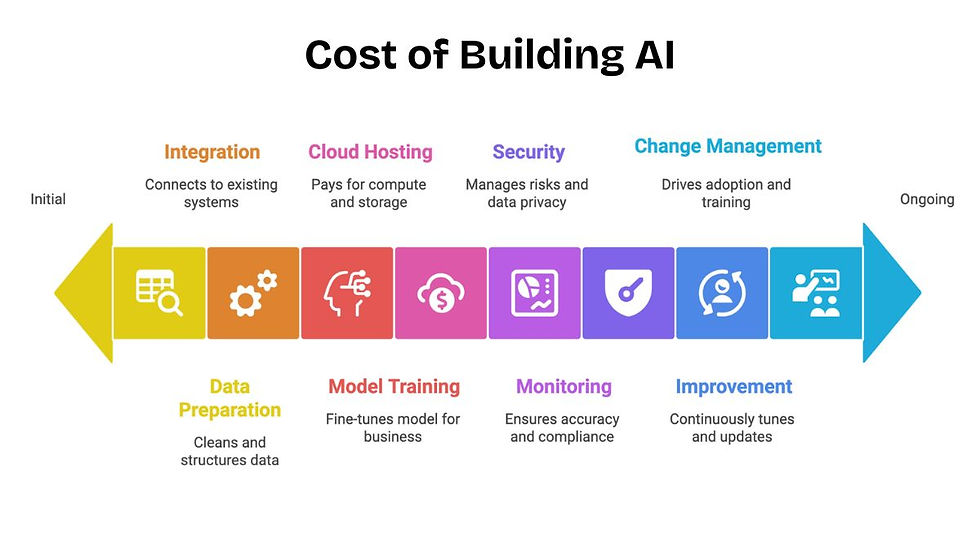
Today, building AI rarely means training your patented foundation model. This is no longer realistic or necessary for enterprises.
It actually refers to owning the following:
Orchestration logic.
Prompt architecture.
Integration layer.
Governance framework.
These won't be cheap. For example, Agentic AI development usually costs between USD 40,000 and USD 150,000 per autonomous agent. On top of that, governance requirements add another 20% to 35%.
Consider this before making an enterprise AI vendor decision.
The Buy Case: Speed, Scale, and Knowing What You Can't Build
By default, buying is the right choice for competitive differentiation. In 2026, foundation models, embedding technology, agent frameworks, observability tooling, and AI infrastructure are all commodities.
Vendors have already optimised these at scale. Hence, building them in-house is a misallocation of engineering talent.
Pricing models are unique. The subscriptions include freemium, user-based, outcome-based, and usage-based. About 65% of vendors use a hybrid approach that might be perfect for your enterprise.
Without hesitation, make an enterprise AI vendor decision by buying:
Foundation model APIs.
RAG pipeline infrastructure.
Observability tooling.
Monitoring infrastructure.
Pre-build agent frameworks.
Some Vendor Lock-In Questions

Want to sign an AI vendor contract? Remember to include these questions in the procurement conversation:
Can you export without data loss? This will discuss data portability at scale.
Who controls the AI model? A question about security and regulations.
What does scalable pricing look like? Talks about production workloads when usage increases.
Is the vendor stable? Understand the risk of failure.
According to Zapier, AI vendor loss disrupts three out of four enterprises. That's why 44% of them now use multiple vendors to hedge the risk.
The Case of Orchestrating AI: Where Enterprises Actually Win
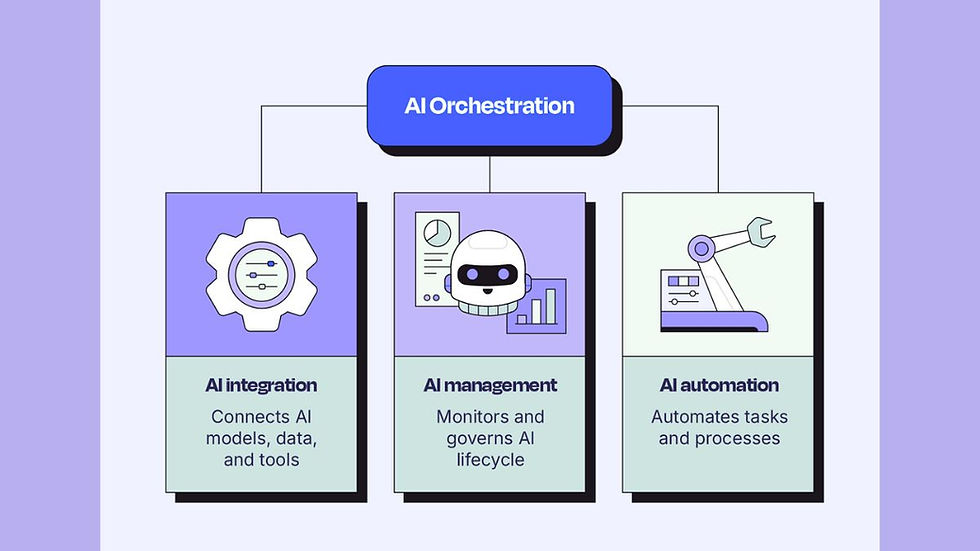
Orchestration connects the AI agent with enterprise data and operational workflows. Turning this into a unified system helps your enterprise in multiple ways.
For instance, it's no longer a product you buy or a feature you enable. This is a strategic decision about control inside your enterprise.
AI investment increased a lot last year. About 85% of organisations bought AI tools. This year, it can jump to 91%.
Your enterprise can own the orchestration layer. That's where business logic lives:
How agents use tools.
When they escalate to humans.
How they share context across teams.
Don't outsource this layer to an AI vendor. Otherwise, you're literally distributing the evolution of your product's intelligence.
Are you operating at scale in a regulated industry? Then, this would be an unacceptable trade-off.
If you want to build serious AI infrastructures, you'll need a specialised partner. AI Strategy and Execution experts at Fruition will get the architecture right before it calcifies.
Our partner-led model will help you design and implement the orchestration layer. We'll help build effective strategies that implement automations and AI capabilities to achieve measurable ROI.
Fruition's got proven frameworks and expert consulting to make AI operational and adoptable. Reach out to us to know more. Our team can help you make the right enterprise AI vendor decision.
Orchestration at Scale: What It Looks Like in Scale?
Orchestration might sound architectural. But it produces exceptional ROI operationally.
JPMorgan's LLM Suite is a great example. They didn't rely on a collection of standalone tools. Instead, they build a coordinated, intelligent layer.
It orchestrated 450+ daily production AI use cases and automated 360,000 hours. Portfolio managers could also complete cycles about 83% faster. They connected workflows, human oversight, and AI models across the entire firm.
How Do Organisations Use Orchestration?
Organisations that moved past the theory of orchestration are now building specialised, collaborative systems. For example, they have a central coordination where the following happens:
One will qualify leads.
Another can draft personalised outreach.
The third validates compliance requirements.
The compounding effect? That's what makes orchestration strategically sound, compared to buying and building AI tools.
Every agent your company deploys will benefit from existing integrations, data connections, knowledge structures, etc.
The Vendor Flexibility Argument
With orchestration as your enterprise AI vendor decision, you can treat vendors as an interchangeable component. Value will be in the orchestration layer, not on the individual agent or model.
Therefore, vendors won't be a rigid strategic dependency. You can upgrade, replace, and swap agents without disrupting the broader system.
Today's market shifts in terms of the following:
Model capabilities.
Pricing structures.
Vendor stability.
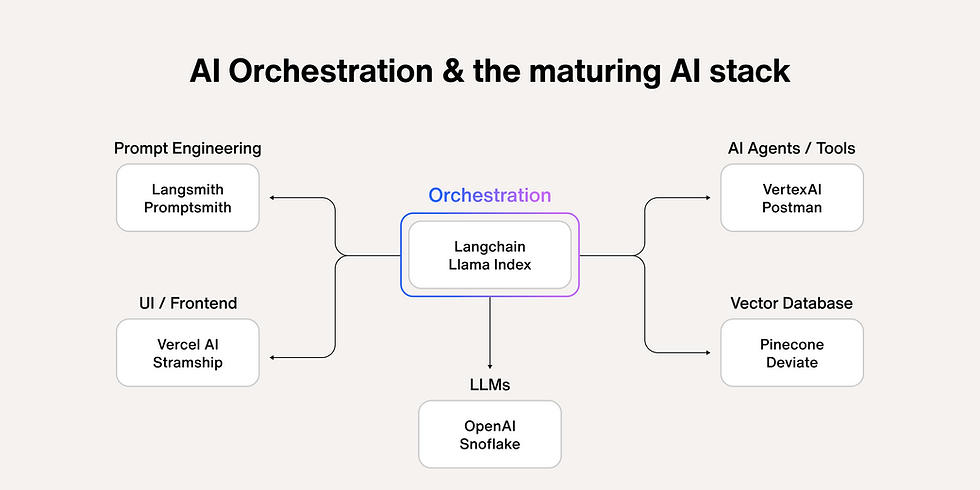
That's why decoupling has become worth more than most procurement teams. You'll need platforms that support multiple model providers. Examples include open source, OpenAI, Anthropic, etc.
They'll offer flexibility through model routing and an abstraction layer. This is essential to avoid dependency on a single provider.
Governance Isn't Just a Layer You Add
What's an expensive enterprise AI orchestration mistake? Funnily enough, it won't be technical, but a sequencing one.
If you deploy agents first and then design governance, then you're in for a rollercoaster ride. You can discover that retrofitting controls onto live systems is much harder than embedding them initially.
You'll need an orchestration platform to handle memory, tool access, observability, and session management. You'll need the control surface needed to govern agentic behaviour.
Before scaling:
Audit trails: All agentic AI decisions should be reviewable and traceable.
Compliance alignment: Built-in HIPAA, sector-specific, and GDPR requirements.
Access controls: Role-specific permissions for AI agents to see and act on.
Model versioning: Roll back without breaking enterprise-wide dependent workflows.
Escalation logic: Defined rules for when agents hand off to your team.
monday WorkOS illustrates this well. This tool embeds governance into its workflow logic. Examples include escalation rules, audit logs, permissions, etc.
These aren't simple features, but structures.
5 Ways to Route Every AI Investment
Do you want to route AI investments correctly? Then, you'll need a structured set of questions asked in sequence.
This isn't a gut call made in your meeting room before mapping out actual trade-offs. Reports suggest that the global AI SaaS market will have a 36.59% CAGR by the end of 2026.
To ensure a successful enterprise AI vendor decision, use this routing logic:
Build the proprietary layers: Is this capability a source for margin, defensible, or revenue differentiation?
Build your own environment: Does your enterprise's data sensitivity rule out third-party involvement?
Evaluate seriously before building: Can this AI vendor solution match specific use cases and categories?
Build capability concurrently and trade one dependency for another: Will your team have the capacity to own this after delivery?
Orchestration delivers strong returns: Will you deploy more than one agent across departments?
The goal? Not a permanent answer. This decision will be honest but should have scope to scale as AI capabilities evolve.
To End With
The build vs buy debate could have worked when AI was just a feature in SaaS tools. Today, it has transformed into an infrastructure that demands proper architecture.
According to Fortune, 42% of companies scrapped their AI initiatives due to fatigue and strategy issues. How can you win?
Indeed, the successful enterprises aren't the ones with the 'best' models. They're the ones who've created an AI ecosystem for governance, integration, and orchestration layers.
It was never about the enterprise AI vendor decisions. This has always been about who controls the intelligence layer the best. Your AI investment (whether bought, partnered, or built) should compound over time.
FAQs
How do AI regulations affect vendor selection?
There are emerging regional AI regulations in the EU, the US, and Asia. They will directly shift vendor selection from a performance-focused to a risk-based assessment. It'll determine which vendors your enterprise can legally and operationally use. This makes compliance, transparency, and data governance procurement prerequisites.
Are the AI decision frameworks the same for small businesses and enterprises?
Not exactly, SMBs shouldn't typically use the same AI vendors as enterprises. Even then, the initial goal is to use AI for performance improvement. SMBs still lack the engineering, resources, and monetary capacity for custom builds. They should go for vendor-led pre-built solutions.
Should enterprises review AI vendor strategies?
AI vendor capabilities, risk profiles, pricing models, etc., shift rapidly. That's why it's recommended to review your AI vendor strategy every six months. Treat AI procurement as an operational discipline and not a one-time decision. This will help your enterprise stay out of regulatory and legal trouble.