.png)


The AI Agent Playbook: Can You Deploy Autonomous AI Without Draining Your Budget in 2026?
- Ishani Dhar Chowdhury

- Apr 11
- 8 min read
Can enterprises use AI Agents without blowing company budgets?
Budget drains stem from poor system scoping techniques. The AI Agent technology itself isn't at fault.
Enterprises can avoid draining their operational budgets. That'll be with a systematic and phased approach. Don't revamp entire departments without focused plans.
You should start with high-frequency tasks that have low precision. Here, errors will carry minimal consequences, and 90% accuracy will be acceptable.
During the early deployment of AI Agents or Chatbots, this will reduce the risk and cost. Remember, the smartest implementations will start with single repetitive workflows.
After validating it, you can expand to avoid expensive over-engineering. Companies like Fruition reinforce this by recommending a process audit before builds. This identifies where automation can eventually generate the best ROIs.
To sum it up, enterprises must start small with autonomous AI and measure its impact to scale deliberately.

What if you've got J.A.R.V.I.S. (Tony Stark's AI Digital Assistant) on your team? This is no longer a science fiction 'what if' question anymore.
It's reality now. Imagine this: Your most productive team member doesn't need lunch breaks and never sleeps. How? Well, the answer is the integration of AI Agents into your business operations.
Reports about the AI Agents market size have noted a 49.60% CAGR between 2026 and 2033. By then, this industry will reach USD 182.97 billion.
The reason? Increased automation demands and rising personalisation options for customer experience. That's why enterprises are scrambling to claim their very own J.A.R.V.I.S.
Businesswire highlights that 51% of companies worldwide are already using this technology. Do you still want to watch from the sidelines nervously with coffee in hand?
You might be wondering whether you can deploy autonomous AI, such as Chatbots and AI Agents, without torching your budget. In this blog post, we'll break it all down.
New Digital Teammates Explained: What Are AI Agents?
Think of AI Agents as the Samurai of your tech stack. Each of these entities will be a specialist who'll work autonomously for your business goals.
They'll enhance your operational workflow when solving a problem. Unlike Chatbots, these agents won't answer and wait. Instead, they'll plan and act after thinking.
IBM's definition: A system that autonomously performs tasks by designing workflows with available tools.
They'll encompass functions like:
Decision-making.
Problem-solving.
Interacting with external environments.
Performing actions autonomously.
What Can These Agents Do?

Gartner states that 40% of enterprise applications will soon be integrated with specific AI Agents. This statistic is up from 5% in 2025.
It's all thanks to the following capabilities of Agentic AI:
Multi-Step Tasks: Agents can execute multiple steps in any task without needing constant human approvals or input.
Fully Connected: They can seamlessly integrate with your entire tech stack and existing tools. (Databases, email, CRMs)
Adapt Contextually: These agents can evolve with each task and adapt context when conditions change mid-workflow.
24/7 Work: Similar to Chatbots, they can also work all the time without error buildup.
What Are the Actual Costs of Using AI Agents?
Budgets might overrun when you start plugging AI into existing business workflows. According to WebFX, 69% of businesses spend between USD 50 and USD 10,000 a year on AI tools.
When it comes to autonomous AI, here's what the integration layer can cost:
Standard API connections between one/two systems can cost up to USD 4,300.
Complex and legacy integrations with three or more systems reach almost USD 8,500.
Workflow orchestration and integration as a full stage can add to these based on complexity.
CRM integrations required up to USD 10,000 in professional implementation costs.
Enterprises often underestimate integration work. That's why you must plan AI Agent implementations slowly.
Get the Most Out of AI Agents: 5 Ways Not to Burn Your Budget

Did you know that 95% of generative AI pilots often fail? Deploying AI Agents is easy. However, getting value without financial chaos can be daunting.
A smart deployment involves how deliberately you execute. Otherwise, it can turn out to be an expensive experiment. Take a look at how to do it right:
#1. Start Small: Automate the Low-Precision & High-Frequency Tasks
Don't overhaul anything. And definitely avoid transforming multiple workflows at once.
Instead, you must choose one high-impact starting point. This can be invoice processing, lead qualification, and customer support.
Consider them a low-risk use case to address operational pain points. As a result, you'll get measurable returns by building confidence in Agentic AI.
#2. Build Human Oversight: Get Insight Into Every Workflow From Day One
Industry leaders always say, "Autonomy without guardrails is simply a liability." To make AI Agents an asset, you must deploy a smaller agent tier to clear workflows for high-performing teams.
During the initial stages, keep human approvals for high-impact actions. Examples include external emails, customer content, payments, and more.
Take into account governance frameworks with explainability, auditability, and ethics. These fundamentals will build enterprise trust in AI systems.
#3. Integrate AI Agents: Use the Tools Your Team Already Knows About
Remember this: Your agents will be useful as long as they can access the right systems. You'll need your agentic workflows to have secure, reliable access.
Without the right plan, you cannot connect these tools with production systems such as ticketing apps, data platforms, CRMs, etc. That's where an AI Strategy and Execution expert comes in.
#4. Clear Success Metrics: Define This Before Deploying Autonomous AI
You cannot justify workflows if you cannot measure AI. That's why you must define all the measurable KPIs before deployment. These include the following:
Accuracy rates targeting 95%.
90% task completion rates.
Overall response times.
Business impact metrics. (Productivity improvements and cost savings)
Did you know AI success isn't about the number of pilots launched? Instead, it's about the ROI achieved and business outcomes.
#5. Train Teams: Orchestrate and Don't Just Operate with Agentic AI
We've entered an era where the human role is no longer needed. We now have to direct agents to do tasks on our behalf. IBM reports that this is building governance and trust for autonomous systems.
The benefit? Human talent can now move away from repetitive tasks. They'll perform well in creating high-value strategies.
That's why leaders must now master AI orchestration, measurement, and governance. With the right tactics, they will upskill teams, leading to better agent workflow management.
Real-World AI Use Cases: What's Driving Results Right Now?
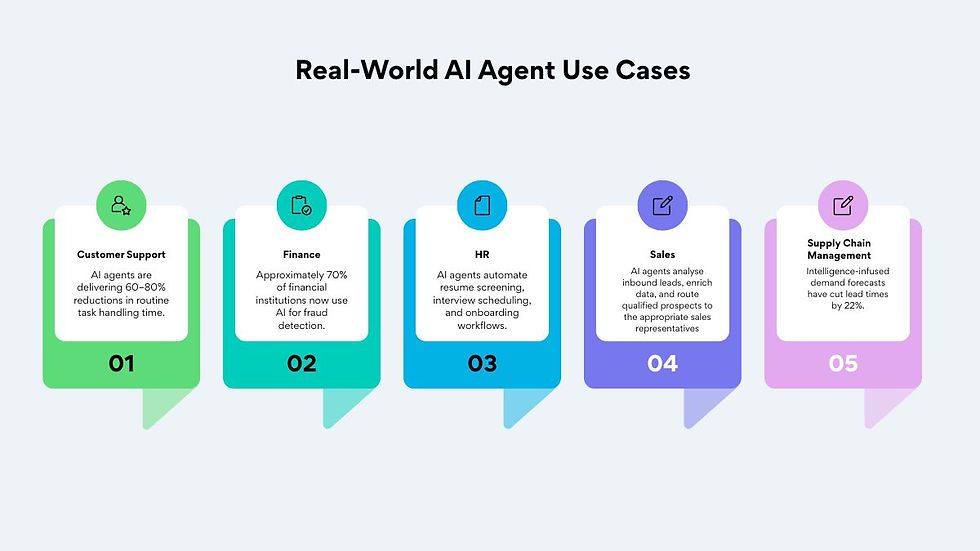
Gartner reports that the use of autonomous AI has led to a 30% reduction in operational costs. The five common use cases of this technology include the following:
Customer Support: AI Agents reduce the time spent handling routine tasks. It resolves all queries autonomously and can escalate complex cases to your team.
Sales: Use AI to analyse inbound leads and enrich data. This will help route qualified prospects to sales reps, reducing time wastage and compressing pipeline cycles.
Finance: Financial institutions use AI to reduce false positives and fraud detection. They can improve detection speed and reduce errors in human oversight.
HR: Automate resume screening to help with interview scheduling and also streamline onboarding workflows. AI can also answer employee questions and free recruitment teams for other strategic initiatives.
Supply Chain Management: Agentic AI gives operations teams real-time visibility that they initially lacked. Examples include intelligence-infused demand forecasts, reduced lead times, and expedited shipments.
monday.com AI Agents: How Do They Help Enterprises?
monday users will now have a dedicated digital workforce to help reduce repetitive workflows. In an article about AI Agent Factory, we noted how monday.com AI features helped reduce manual work by 50%.
The AI Agent Factory in monday WorkOS takes that even further. They'll enable the following:
Autonomous decision-making.
Complex reasoning.
Analysing content.
Following up and taking action.
Generating content.
Making judgment calls.
Executing multi-step workflows.
Ready-made agents in monday will cover every team. They'll operate without volume, time, and language constraints.
Examples include the following:
Sales Agent to qualify and book meetings.
Bug Prioritisation Agent for engineering.
Customer Support Agent who drafts responses and reviews tickets.
Should You Choose Fruition for AI Strategy and Execution Services?

The team at Fruition can transform fragmented business processes. We can turn them into a cohesive, automated system.
With the proven AI Strategy and Execution tactics, Fruition can enhance team collaboration to deliver measurable ROI. Your entire organisation will go from 'being curious about AI' to 'fully operationalised at enterprise scale.'
This is what sets us apart:
Process Discovery
A business process audit.
Uncovers workflow constraints.
Determines performance deficiencies.
System Integration
Detailed technical evaluation.
Identifies specific automation strategies.
Turn isolated procedures into operational systems.
ROI Analysis:
Identifies process enhancement.
Generates maximum financial returns on technology investments.
Adoption Strategy
Validated transformation methodologies.
Converts potential pushbacks.
Enthusiastic system adoption.
Beyond these, our team also ensures continuous improvement. The workflows we create will be refined based on your enterprise's KPIs. We'll also add new automation use cases as your business scales.
Are AI Agents Worth the Investment in 2026?
Early AI tools (Chatbots) could only assist. However, autonomous AI can plan, reason, and take action across multi-step workflows.
Agentic AI is now shifting from the 'hype' phase to a pragmatic and outcome-driven investment.
CEOs will witness an increased AI investment rate, leading to promised productivity gains. Organisations will also see about 10x ROI from every dollar spent on AI Agents.

They'll provide the following:
Action-oriented ROI.
Efficiency at scale.
Low-code accessibility.
Niche specialisation.
How to make this investment worth it? Have sound governance, the right implementation partner, and deploy with clear metrics.
In The End
As you can see, AI Agents are already here, changing the business game. Is your enterprise ready?
Capgemini reports that 93% of business leaders think scaling AI Agents will provide a competitive edge. However, nearly half of them lack an implementation strategy.
Here's the thing: The idea of an autonomous digital teammate is no longer a future prediction. AI Agents and Chatbots have now become an operational reality.
They can navigate software and execute multi-step workflows. In some cases, autonomous AI can also qualify leads and generate reports. This technology can truly free human teams to focus on creativity and strategy.
Beyond all the positives, the budget drain risk remains real. Thankfully, it can be managed with the right techniques. That's where Fruition comes in to operationalise Agentic AI adoption at enterprise scale.
We can transform your fragmented processes into an automated system. With the right AI tactics, we will enhance team collaboration to deliver measurable ROI.
FAQs
Will Agentic AI work across various software platforms?
Modern AI Agents and Chatbots can integrate with multiple SaaS tools. For example, it can connect with email systems, ERPs, and CRMs simultaneously. This cohesion will help execute cross-platform workflow operations without human intervention.
Are there any governance risks for deploying autonomous AI?
Enterprises should create clear data access boundaries when integrating AI Agents. You'll also need compliance frameworks and an authentication protocol. Otherwise, autonomous agents will lead to data privacy breaches. As a result, your enterprise can face security vulnerabilities and unintended regulatory exposure.

